
Rinse, Repeat, Revolt
Why National's latest leadership drama is not an ending, but another chapter in an unresolved political struggle.

Back in April, I wrote a Substack titled Rinse and Repeat about National’s attempted leadership spill. Four months later, the same dynamics are playing out once again: another leadership challenge, another ‘victory’ for Chris Luxon, another distraction for National, and little sign that the underlying causes have been addressed.
Rinse and repeat

Another week, another round of speculation on the leadership of the National Party. As I write, the latest iteration has been put to bed with Christopher Luxon calling a vote on his leadership and winning.
While the drama of the past few days has subsided, my central argument remains unchanged. This is another rinse and repeat episode, and there will almost certainly be more to come. What we have witnessed is not the end of the story, but merely a pause in it.
Having witnessed five leadership changes during my time in Parliament, three of them difficult and acrimonious, I deliberately waited before writing. The situation is messy, complicated, and difficult to fully understand. I also wanted time to gather information and sort fact from rumour. Just because a reporter or commentator says something does not make it true. Equally, just because I hold a particular view does not make it correct.
As with any political party’s internal wranglings, few people have a complete picture of what is happening, including some directly involved in the events themselves.
Although the timing of recent events may have surprised some observers, the fact that they occurred was entirely predictable. Until the internal rivalries, ambitions, and personal calculations driving this instability are either resolved or exhausted, little is likely to change within National.
One of the broader drivers is the increasing tendency for MPs across the political spectrum to drift away from the core values and principles of their parties. Filling that vacuum are individual ambitions and the pursuit of influence. Ambition has always been part of politics and always will be. The difference is that ambition was once more commonly directed towards advancing a party’s objectives and principles, rather than personal agendas.
A convergence of catalysts
Questions are rightly being asked about what triggered these events and what dynamics lay behind the whole sorry saga. Was this primarily a media-driven event, or something more substantial?
There was no single cause. Rather, it was a convergence of factors.
The foundation remains personal ambition. Every political party contains people willing to seize opportunities to advance their own position, regardless of the wider consequences.
Nor can Chris Luxon’s own missteps be ignored. Whether it was his remarks to the Rotorua business association or the unexpected intervention around MMP, these incidents have contributed to a cumulative problem. For better or worse, a perception of his performance has become established. Every unforced error reinforces that perception and gives opponents and commentators fresh material to work with.
We then come to the National Party list.
From an outsider’s perspective, the list may appear relatively unremarkable. For MPs, however, it matters enormously. For list-only MPs, it can determine whether they remain in Parliament. For others, a ranking can feel like a demotion that must be explained to supporters and local members.
As I have often said, for some MPs to move up the list, others must move down.
It is therefore unsurprising that an attempted spill emerged so soon after rankings were announced. List rankings are periods of heightened sensitivity within caucuses, and political tensions are often magnified.
Linked to perceptions of an uninspiring list is another perception: weak leadership. Fairly or unfairly, voters often associate boldness with strength and caution with weakness. As recent events demonstrated, even a relatively modest reshuffle proved enough to fuel internal discontent. One can only imagine how a more dramatic reordering of the list might have been received.
The same applies to portfolio reshuffles.
There is also the question of media involvement. Some have suggested the media merely reported events, while others argue it helped create an environment in which MPs felt emboldened to cause trouble.
My view is that such stories almost always begin with MPs talking. Whether deliberately or carelessly, politicians leak information, brief against colleagues, and use journalists to advance internal battles. That is hardly unique to National.
At the same time, parts of the media were eager to amplify the story. What may have begun as internal conversations quickly developed into a full political spectacle. It is not unreasonable to conclude that some commentators saw an opportunity to further damage both National and its leader.
There is also an observable difference in how political parties are treated by some mainstream outlets. Many appear ready to scrutinise every Luxon misstep while showing less interest in the difficulties facing political opponents. Whether one agrees with that assessment or not, it reflects a reality National must learn to navigate rather than complain about.
National’s response should be strategic rather than emotional. Greater use of social media, independent podcasts, and alternative media platforms would seem an obvious approach. Yet Luxon and National continue to devote significant attention to media organisations that are often deeply critical of them, in a vain hope of being liked or securing more favourable coverage.
A coin has two sides
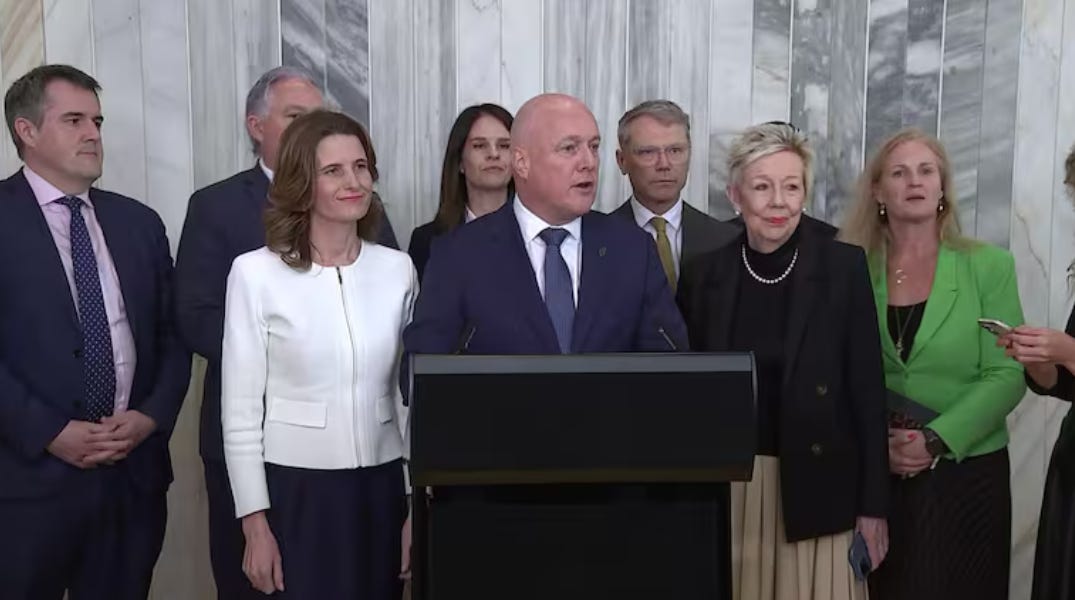
Much has been made of National’s messaging following the attempted coup. Critics have pointed out that what party leaders are saying publicly does not always align with what observers see in MPs’ expressions, comments, or behaviour. The now-famous post-caucus media stand-up perhaps illustrates this best.
National is attempting to advance several explanations that cannot all be true simultaneously.
There cannot be unanimous support for a leader while caucus is actively debating that leader’s future. Likewise, it is difficult to argue the whole affair was merely media hype while also dismissing a Cabinet Minister. Nor does an emergency caucus meeting during recess sit comfortably alongside claims of complete unity.
Yet politics often requires parties to project confidence regardless of internal realities.
In that sense, National is entirely correct to speak about unity, strength, and election readiness. Leaders do not emerge from crises telling the country their caucus is divided and uncertain. Luxon’s closing words at his brief press conference were therefore exactly what was required:
“We’re going back to work, and we’re moving on.”
Whether that message reflects political reality is a separate question. Nonetheless, it was the right message to deliver.
The scapegoat
I completed one of my postgraduate dissertations on scapegoating and remain a great admirer of Rene Girard’s work in this area. The dismissal of Chris Penk displays many of the characteristics of a classic political scapegoat.

After April’s leadership tensions, there were few meaningful consequences for those involved. Some portfolios shifted, but there was no obvious demonstration that actions had consequences. This time, Luxon needed to demonstrate authority. That need found expression in the dismissal of recently appointed Cabinet Minister Chris Penk.
There was almost certainly some basis for the decision. True scapegoats are rarely entirely innocent; there is generally some connection, however tenuous, to the behaviour being punished.
However, the suggestion that Penk alone was promoting himself as an alternative leader is difficult to accept. A more plausible interpretation is that he was prepared to articulate concerns that others privately shared. As commentators have observed, his military background, legal training, and conservative convictions suggest someone more inclined to speak frankly than remain silent.
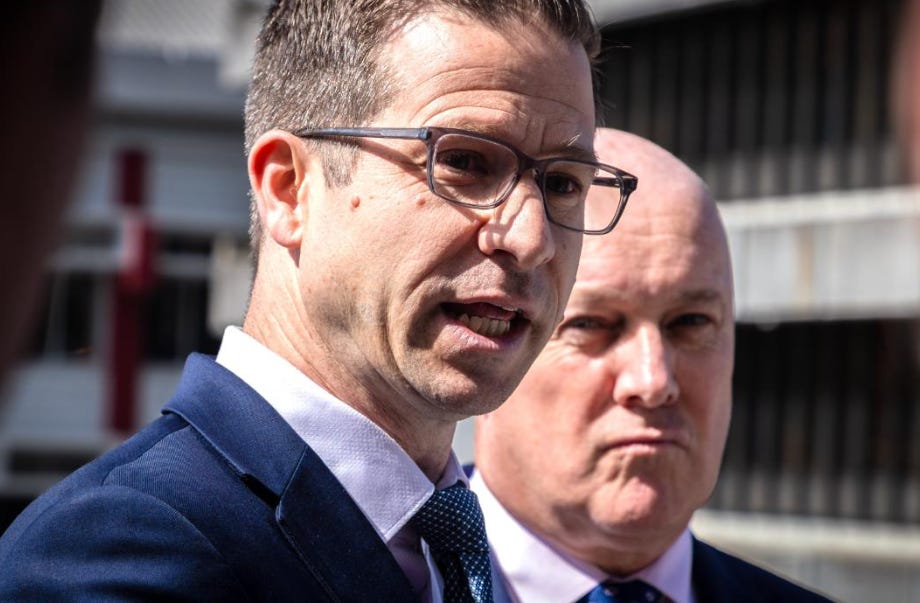
Penk represented the easiest target through whom decisive action could be demonstrated. His removal allowed Luxon to project authority while limiting the risk of wider political fallout that sacking other, more likely troublemakers, would have caused.
Some final thoughts
Despite these difficult days, there remains a clear path forward for National.
A renewed commitment to its foundational principles would be a good starting point, alongside an unrelenting focus on policy, greater consistency between rhetoric and action, and a clearer understanding of why voters elected it in 2023.
While many voters are frustrated by the internal turmoil, the broader centre-right vote is likely to remain relatively stable. National may lose support to ACT and New Zealand First, but the overall balance between left and right is unlikely to shift dramatically.
Many voters are unhappy with National’s internal fighting. At the same time, many are equally wary of a Labour, Green, Te Pāti Māori, or TOP-led alternative government.
National’s challenge is therefore not simply to win the next election, but also to resolve its internal problems. Ironically, for the reasons I wrote in ‘Rinse and Repeat’ back in April, the former may be easier than the latter!
Made it this far?
A quick heads up on a few other aspects of interest. My wife, Rachel, has started her own Substack which is pretty cool and you can find her here:

I’ve also been keeping busy with podcasts, online radio, and commentary in mainstream media. One recent podcast for Family First was with Dr Gavin Ashenden:
And on RCR online radio, I sat down with Nathan from PILLAR NZ to talk the push for blasphemy laws and police overreach:

I think Luxon means well, but National were voted in on a promise to address He Puapua and they have most decidedly not done that.
Leadership in the current era where sound bites get traction and detail gets lost must be very difficult when trying to operate a turnaround program at country level.
Luxon has made slip-ups that have clearly made his list MPs anxious, however this is not the reason I'm no longer a National Party supporter. I can understand the need to focus on an economic plan to be able to service the massive debt run up by the previous administration, but in the process the vitally important restoration of social cohesion got lost, along with a powerful vision of strength and unity to counteract years of racial division.
Luxon failed dismally to deliver on the policies that would have arrested the maorification of this country. The turning point for me and anyone I know speaking honestly about it was his woke attitude towards the Treaty Principals Bill and lack of any alternative program to replace it. Instead gun-shy Luxon left it to ACT and NZF and is now wondering why his popularity is Hipkins level; or less.
Strength of leadership is what we need. I'm hopeful that Luxon will learn from the rinse & repeat pattern and we as a nation can breathe easy knowing that we have another reprieve from the ruinous left bloc parties after this election.