
Foreign interference is very real in New Zealand
I recently gave a speech to MPs, academics, journalists, and the general public on foreign interference in New Zealand, sharing some real and personal stories of mine.

This is not my regular Substack. It is a copy of a speech I recently gave to those attending a symposium on foreign interfernce, hosted by the Tasman Alliance and co-sponsored by the Free Speech Union and New Zealand Values Alliance. It was a gathering of academics, Members of Parliament, journalists, ambassadors, influencers, and the general public.
Free to believe
Thank you to all the organisers for the opportunity to be here, and thank you for arranging this important conference and discussion.
I’ve been asked to talk primarily about the importance of freedom of belief – something relevant to New Zealand, China and Hong Kong, Tibet and Taiwan, and in fact in every part of the world. I’ve also been asked to highlight some of the work of a group called IPAC – or the Interparliamentary Alliance on China.
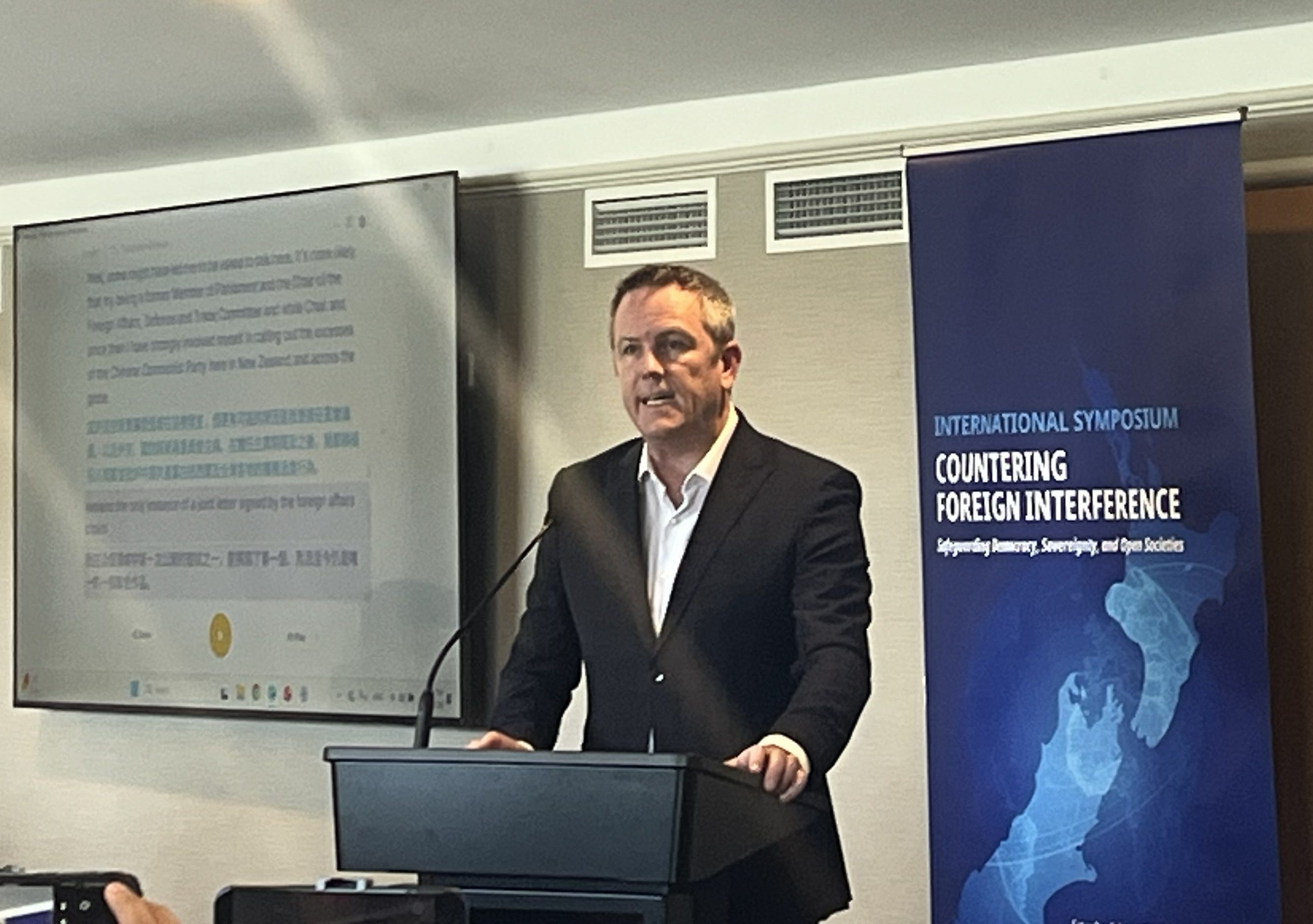
First, to quickly introduce myself. My name is Simon O’Connor – a husband, step-father to five kids, and I currently run a consultancy where I host podcasts, online radio, and help clients with strategy and campaigning.
I have an academic background in philosophy and theology, including training - of all things - as a Roman Catholic priest for nine years.
While some of this might have led to my being asked to speak, it is more likely that I am a former Member of Parliament and Chair of the Foreign Affairs, Defence, and Trade committee. While Chair, and since then, I have been strongly involved in calling out the excesses of the Chinese Communist Party (CCP) here in New Zealand and across the globe.
One my first public acts in this space was to write the first ever – and remains the only instance – of a joint letter signed by the Foreign Affairs Chairs of New Zealand, Australia, Canada, and the United Kingdom. We had written this joint letter to the United Nations Secretary General expressing our deep concerns about what was happening in Hong Kong. The four of us remain in contact and our concerns remain.
Alongside Louisa Wall, I set up the Interparliamentary Alliance on China (IPAC) here in New Zealand and was its inaugural co-chair. I now sit on the Alumic Council of IPAC – a group of former MPs and Senators – and continue my efforts there.
Can I thank Helen White MP and Joseph Mooney MP for continuing as IPAC Chairs here in New Zealand, and Todd Stephenson MP and others for being members. It is an essential voice and I encourage you to speak up for what is right, even if at times, it is difficult.
IPAC exists to hold China (the CCP) to account – not only its autocratic rule of China, but also its interference in democratic countries around the world. It is an organisation I am very proud to be part of, even if it has come at considerable cost in different ways. It has had noticeable impact here in New Zealand, although not without facing serious headwinds from political parties and leadership over the years.
As a former MP, I can say that those in parliament must prioritise our democratic structures, our sovereignty and national security – not money and trade deals. We can have both of course, but our democracy matters most.
In my time with IPAC, we can point to many successes – mostly simply giving voice and opposition to what Communist China is doing here in the Pacific. IPAC in New Zealand raised the alarm and obtained a leaked copy of the secret agreement between the Solomon Islands and China, including a long list of military grade weapons being bought into the country. IPAC was able to amplify the work of Safe Guard Defenders, who discovered at least two (potentially five) secret Chinese police stations operating in New Zealand. IPAC has drawn attention to the sources of various political donations, highlighted community organisations’ alignment with Beijing, and unflinchingly called out the egregious behaviour of the CCP in Tibet, Hong Kong, Xinjiang, Taiwan, and elsewhere. We also have drawn attention to the ongoing militarisation of Antarctica by China, including the deployment of their Beidou system. We have consistently called for Modern Slavery legislation and Magnitsky laws and I am pleased to see that Modern Slavery is finally before the parliament.
I was also pleased, alongside Ingrid Leary MP, to set up the first All Party Parliamentary Friendship Group on Taiwan. I believe it is critical to clearly identify who your friends are, and stand with them. Can I acknowledge Joanne Ou for her assistance and ongoing friendship.
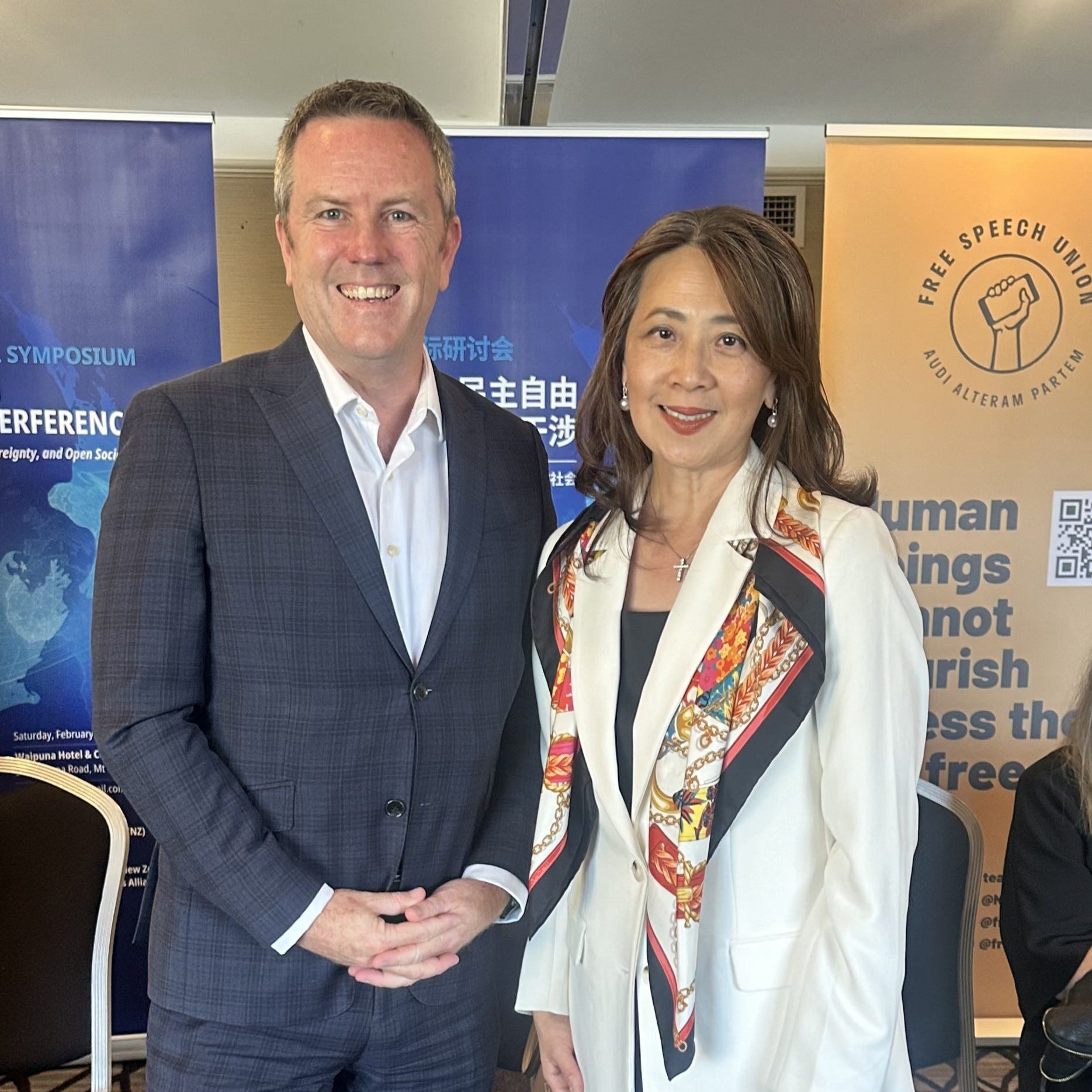
Since then it’s been quite the ride – from raising the ire of the CCP embassy (receiving frequent phone calls to tell me off for my opinions); having my parliamentary email targeted by a Chinese State sponsored hacking group (APT 40); and more recently named in the court case against Jimmy Lai as a ‘foreign agent endangering Hong Kong and China’s national security’.
When it comes to the place of religious freedom or the freedom to believe, can I quote from Karol Wojtyła, better known as Pope John Paul II. In an address to the United Nations in 1995 he said:
“Our respect for the culture of others is therefore rooted in our respect for each community’s attempt to answer the question of human life. And here we can see how important it is to safeguard the fundamental right to freedom of religion and freedom of conscience, as the cornerstones of the structure of human rights and the foundation of every truly free society. No one is permitted to suppress those rights by using coercive power to impose an answer to the mystery of man.
To cut oneself off from the reality of difference — or, worse, to attempt to stamp out that difference — is to cut oneself off from the possibility of sounding the depths of the mystery of human life.”
He would argue, as would I, that freedom of religion – or freedom of belief, freedom of conscience – is the seminal and foundational human right. It is the right on which all other rights find their grounding, from freedom of speech to freedom of association.
Sadly, we know that the freedom to believe is under constant challenge by the CCP. Whether this belief is religious, political, or philosophical.
Fundamentally, Marxism (or call it socialism, communism) does not like competition. Marxism is a comprehensive ideology. It is not simply an economic vision, but one that seeks to provide meaning and control across all aspects of life. It makes moral claims and certainly in Communist China, the Party seeks to impose its view of what is right and wrong on all it’s citizens. Any religious belief therefore is a threat; it is a competitor and must be silenced or controlled where possible.
We know this is certainly true of the persecution of the Tibetans, Uyghurs, those of Falun Gong, and house Christians.
For us here in New Zealand, we must ensure we express and practice our belief. To those in our New Zealand-Chinese community, we must ensure people know they are free to believe what they wish in this country.
The challenge is not simply in China however; it is also here in New Zealand. I think back to Falun Gong supporters standing in Mission Bay – in my then electorate - holding signs when a man – CCP aligned in my view – chose to have himself filmed slashing their signs with a knife. He then took exception when I decided to draw attention to his ‘CCP thuggish’ behaviour on social media. If memory serves me right, he wanted to have me done for defamation. Personally, I just wanted to ensure his attack on people expressing their belief was publicly highlighted.
We also know that frequent attempts are made by the Chinese embassy and consulate to stop various groups expressing their beliefs. Those from Taiwan here will know of the frequent calls the CCP make to local councils, libraries, or any organisation seeking to host anything to do with Taiwan. I recall the CCP reaction when Canterbury University library put up the Taiwanese flag.

In recent weeks, a friend of mine – Jonathan Ayling – wrote an opinion piece for the New Zealand Herald supporting Taiwan. The response to his belief, his expressing a view, was immediate condemnation by the Chinese embassy here. The CCP cannot tolerate even the slightest dissent, even a glimmer of light. Any belief or view that conflicts with theirs, must be silenced where possible. It also indicates just how much resource the Ministry of State Security, and the United Front, has to monitor these things.
And of course, we had what happened to Portia Mao and her ultimate court win against a CCP admirer and agitator, who initially had her journalist work silenced under New Zealand law. An outrageous situation and when Portia got in contact asking for my help, I was pleased to suggest she contact the Free Speech Union. Can I therefore acknowledge the FSU and the support they have given Portia.
As some in the intelligence community once said to me in private, the CCP knows our laws better than we do! So we must be vigilant.
So the attempts to limit people’s freedom to believe and express themselves is not simply an issue in China but extends to countries like our own.
Two other quick examples. I was pleased to assist a defector here in New Zealand a few years back; who was working in the Chinese consulate. When his Christian faith was discovered and his situation in jeopardy, he defected and in the coming weeks got in touch with me as a fellow Catholic and as a Chair of IPAC. I won’t say much more other than to say I am pleased his young family were eventually able to get out of China – through creative channels - and make it here to New Zealand.
And then we have the persecution of Jimmy Lai. There are many reasons why the CCP has gone after him so aggressively, but part is his unwavering faith – both as a Catholic and also his belief in the good of Hong Kong, but now under the control of an autocratic regime. It grieves me that my and other IPAC members work to speak up for the freedoms of Hong Kong, has been misused by the CCP to incriminate him in this sham trial.

A few last points, notably around what we can do to protect our freedom to believe, our freedom to speak, and to protect our democracy, sovereignty, and national security.
Here in New Zealand, we must remain committed to protecting and promoting our freedoms. We may not be able to do much to directly and immediately assist our friends in Tibet, in the Uyghur camps, or likes of Cardinal Zen, Andy Li, and Jimmy Lai in Hong Kong, but we can do at least two things.
Firstly, to speak up for them whenever we can and draw attention to the injustices. As I noted at the start, the freedom to believe is the foundational human right.
Secondly, we must ensure we protect and use our freedoms here in New Zealand. Encourage your friends and family to express these freedoms as well.
We must continue to speak up for those who are persecuted, particularly overseas. If the freedom to believe is a foundational right, it is here and overseas. We must also call out the continued excesses by the CCP towards the likes of Taiwan, Japan, and others in and around the South China Sea. We must call out China’s continuing support of Putin’s Russia. We must call out China’s militarisation in Antarctica and so on. New Zealand must not be silent because of trade. As I have noted many times when in parliament, if we are to have free trade with China then we should also have free and open conversations.
We must prioritise our national security and sovereignty. I congratulate Pillar New Zealand for drafting a Foreign Influence Transparency Scheme. I do not have time to go into more detail, but among other things, we need our security and intelligence agencies to develop more Chinese language speakers.
Speaking of languages, New Zealand must look far more closely at the Confucius Institutes – as with overseas, there are serious questions to be asked of them.
Finally, an encouragement to everyone here – particularly in election year – to engage your local Members of Parliament. Invite them to your events while also warning them of those community associations that have ties to the CCP. As we all know, such groups use MPs to give themselves legitimacy – both a groups and individuals. We also know the chilling effect on our local communities here when MPs are seen cosying up – often unknowingly – to CCP aligned individuals. I want to stress this - many MPs, mayors, or councillors do not really appreciate this – so each of us has a role to play in educating them.
Thank you to everyone who is part of today. Each of you represent a critical component to hold the CCP to account and to ensure our democratic way of life. Whether an academic or journalist, community activist or Member of Parliament, ambassador or citizen – all of us, together, can make a difference.
Democracy matters, freedom matters – here in New Zealand and everywhere around the world.
The difficulties I have with the rhetoric around foreign interference are 1. We chose to recognize China Beijing in around 1973, and to develop our trade and economic links with them. We need to honour and look after that decision. It's quite obviously an annoyance to them for us to be continually agitating for Taipei independence. And Ms Ou is quite simply not ambassador in New Zealand, thus it's not appropriate for you to label her as such. As much as you do that, you are adding to the very problem that you decry....... And 2. We join ourselves with the US and others in creating provocations, such as sending naval vessels into or close to Chinese waters. If we are there to protect trade,...... well that's lunacy anyway because the Chinese are predominantly those doing the trading and shipping there, and they are quite capable of defending the area themselves - and the only ones glowering and threatening shipping there are the Americans. If the Chinese didn't invite our ships there, we should keep away. It's a matter of respect. But if we continually play along with and participate in the US provocations, then of course we are likely to suffer in various ways. And none of that is in NZ interests. At one time the US consulate in HK had something like 300 staff. Very obviously out of proportion to their regular consular duties, and intended only for interfering in China. Should NZ stop associating itself with this, then the primary motivation for the Chinese to do anything to push things in NZ will be taken away. Again it's very simply about respectful relations. If we stop continually inviting the interference, it will surely reduce.....
The main problem with this is that standards aren't applied equally.
Foreign influence in New Zealand must surely be examined but lets do it honestly.
BeiDou over Antarctica must be measured by exactly the same yardstick as GPS over that exact same continent.
Political influence from Beijing measured by the same standards as that from Washington, and that does not mean measuring everything by whatever the current Washington consensus is.
Far too many people, worried about being a Chinese vassal state at sometime in the future, demand that we remain an American vassal state for all eternity